a mileage log for runners

Run them right.

Soledger keeps a ledger for your soles. Every run goes on the books — so you know exactly when to retire a pair, and what each mile actually cost.
iPhone · iOS 17+ · No accounts · No ads · No tracking
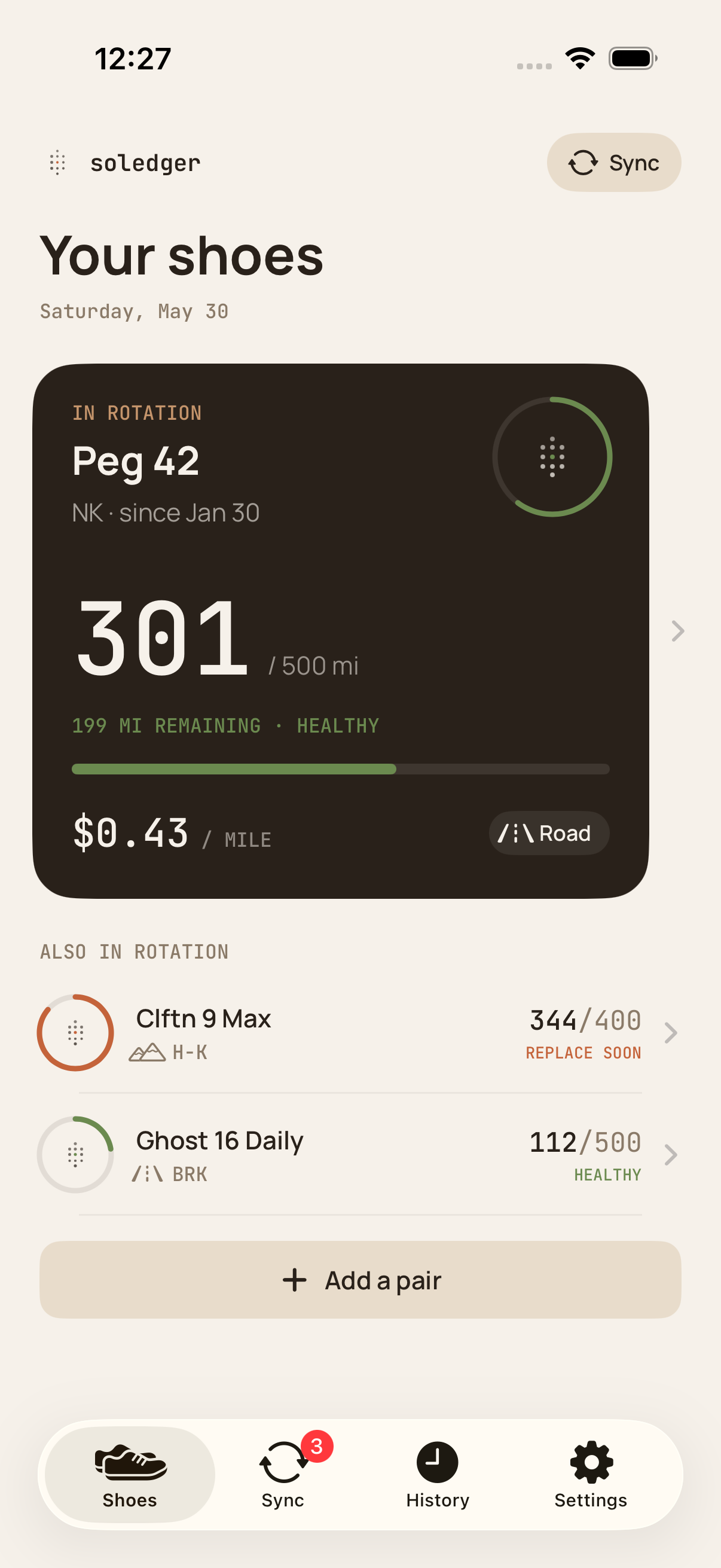
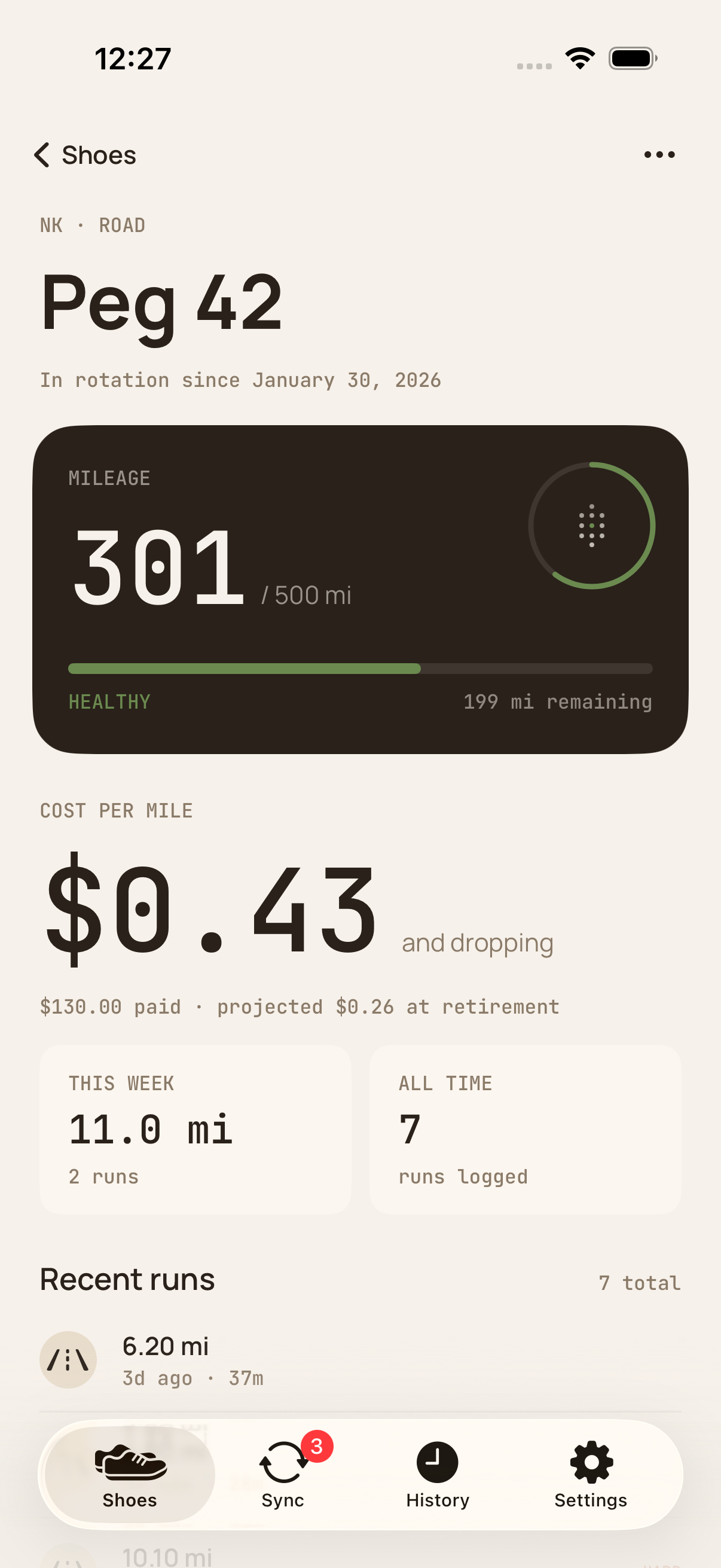
Cost per mile
$0.43
Peg 42
Soledger home screen
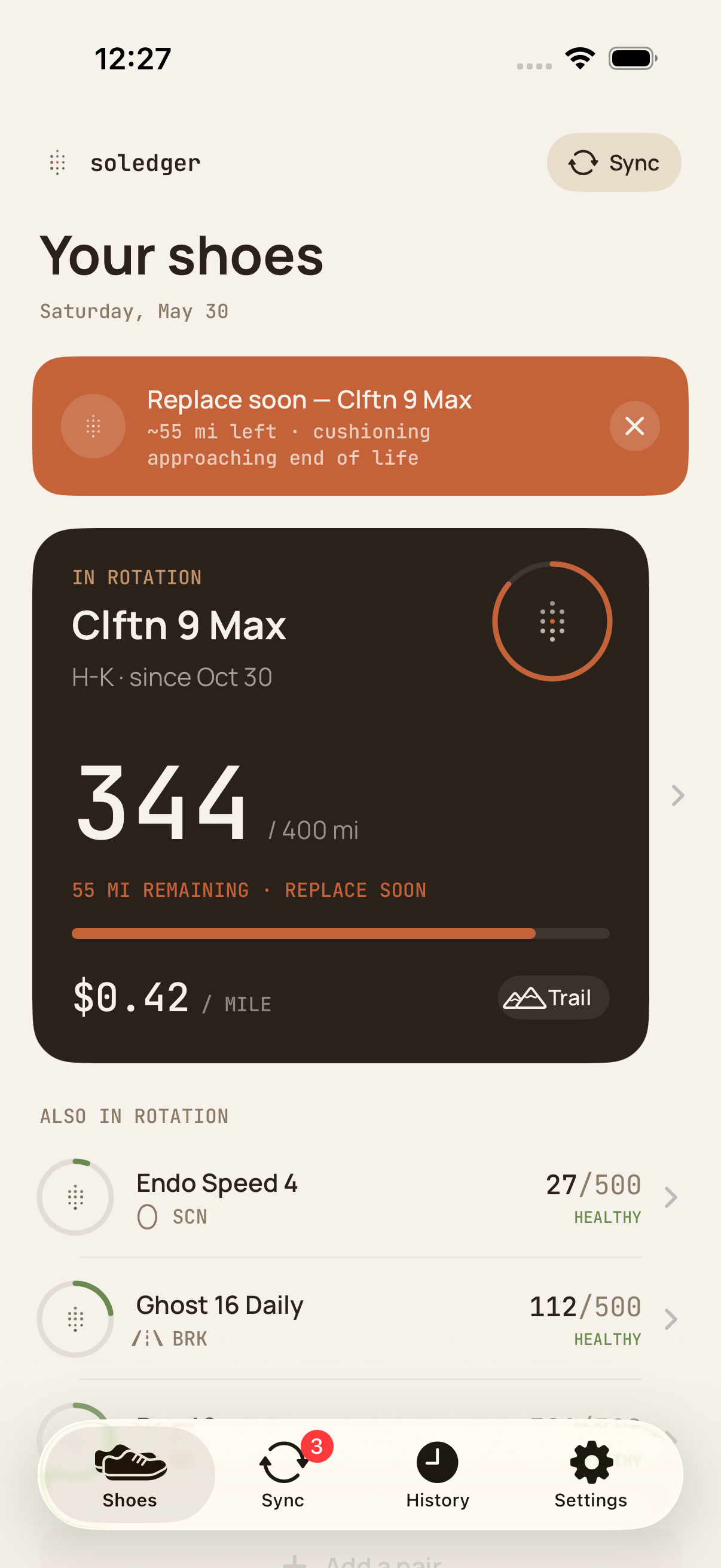
Replace soon
344/ 500
312mi
Total tracked
$0.32/mi
Cost per mile
4pairs
In rotation
86%
Sole life used
why soledger

Quiet, specific, useful.

Most run apps want to be your coach. Soledger only wants to be the ledger — a calm record of what you ran, in which shoes, and what it cost you.

Synced from Apple Health

Your runs already live in Apple Health. Soledger reads them — road, trail, treadmill, track — and asks one thing: which shoes were on your feet?

01 · HealthKit

Cost per mile, finally.

Enter what you paid. Soledger does the math on every run. $0.43 / mi on the Peg 42, $0.71 on the Adizero. Now you know.

02 · CPM

A nudge before you need it

At 85% of a shoe's lifetime, Soledger turns the dial from quiet green to a warm amber — replace soon. No buzzwords, no streaks, no celebration. Just the number, on time.

03 · Replace alerts

Yours. On device.

No accounts. No analytics. No leaderboards, no Soledger server. Your shoes and runs live on your iPhone — and sync to your own iCloud if you have it turned on, never to us.

04 · Private by default

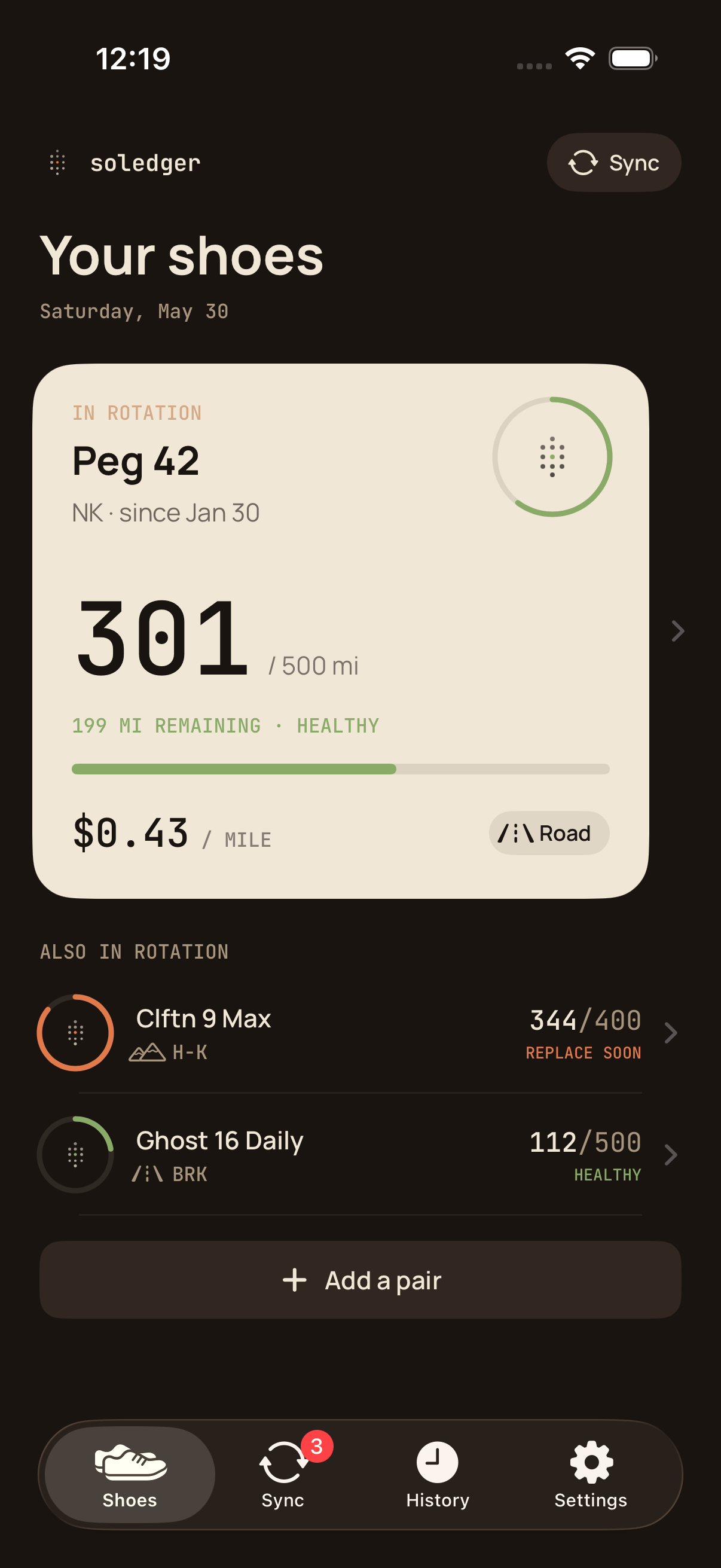
On your Home Screen. On your Lock Screen.

Add the Soledger widget and your active pair's mileage is one glance away — no need to open the app. Home Screen widgets in three sizes, plus a Lock Screen widget for a glance before you even swipe in.

05 · Widgets
screens

Built for a glance.

Numbers do the heavy lifting. Color carries meaning — a quiet green when shoes are healthy, a warm amber when it's time to replace.
how it works

Three steps. No setup tax.

Open the app, add a pair of shoes, run. Soledger does the bookkeeping in the background.

Step 01

Add your shoes

Brand, model, what you paid, where you run them. Set the expected lifetime. Soledger starts with a science-backed default — adjust it to whatever your legs and the rubber agree on.

Step 02

Pick which pair

Soledger reads the run from Apple Health and asks: which shoes? One tap and the mileage is on the books. Bulk-assign older runs in a single sync review.

Step 03

Know when it's time

A quiet green ring while you've got life left. A warm amber when it's time to replace. The shoe earns its mileage; you see what it cost.
the name
sole + ledger
sole
The bottom of the shoe — the part that wears down with every mile.
ledger
A running log of debits and credits — what you put in versus what you get out.
“ · ”
A ledger for your soles. Every run goes on the books.
questions

The honest answers.

Where do my runs come from?
Apple Health. If your watch, treadmill, or another running app writes workouts to Apple Health, Soledger can see them. You'll be asked to grant read-only access to running workouts the first time you open the app. We don't request anything else.
Does Soledger collect any data about me?
No. Soledger has no servers, no accounts, and no analytics SDK. Your shoes and your runs are stored locally on your iPhone. We can't see them, and we don't want to. See the Privacy Policy for the long version.
How do you decide a shoe needs replacement?
Soledger defaults to a research-backed lifetime based on biomechanics studies — roughly 300–500 miles for standard daily trainers, the range at which peer-reviewed research consistently shows meaningful cushioning loss. Trail and indoor shoes get their own defaults tuned to their surfaces. But you're in charge: when you add a pair you can adjust the expected lifetime and a nudge threshold — the miles remaining when Soledger turns amber and sends a replace soon alert. The default nudge is 75 miles out. You can also retire a pair at any time — Soledger never forces it.
What does cost per mile actually mean?
It's the price you paid divided by the miles you've run in them. A $160 shoe that lasts 500 miles costs $0.32 per mile. A $250 carbon-plate racer you only run for short races might land at $1.50. Cost per mile isn't a number to feel bad about — it's a number to know, so you can pick the next pair with eyes open.
Does it work on iPad or Apple Watch?
iPhone only for now. Apple Watch and iPad support are planned for a future version.
Does Soledger have widgets?
Yes — Home Screen widgets (small, medium, and a sync-confirmation widget) and a Lock Screen widget, so your active pair's mileage is visible without opening the app. Free for all users.
Is there a subscription?

Soledger is free to download and free to use for up to 3 shoes (active and retired combined). The free tier includes automatic HealthKit sync (rolling 90-day window), retirement alerts, cost per mile tracking, Home Screen and Lock Screen widgets, iCloud sync (if you have it on for the app), and your full retire/archive history — no time limits, no nags.

Soledger Pro — $3.99/month or $24.99/year — unlocks unlimited shoes, historical sync (import your full Apple Health run history — no date limit), auto-sync rules that skip manual review for recognized workout types, CSV export, milestone alerts (at 50, 100, 200, 300, 400, and 500 miles per pair), and a weekly summary notification on Sunday evenings. Annual plans include a 7-day free trial.

What if I want my data out?
CSV export is available on Soledger Pro. Your runs already live in Apple Health regardless of Soledger, so that data is always yours.
get soledger
Run them right. Starting your next run.
Download on the
App Store
Coming Soon